Monday, July 2, 2012

Laptop Screen Repair

Oh No!
Last year I got a new laptop to replace the old one which developed a broken hinge. It had a good run, lasting me though my Associate's degree and most of the way through my Bachelor's. The new laptop was smaller, lighter, faster, cooler and all around just a really good machine. I declined the extended warranty to save some money (I'm on a very tight budget.)

Just over a week ago, disaster struck. There's a place between the couch and drawers that I often put the laptop. It's closed, in its bag, and in a slightly out of the way place so no one runs over it. No one did. My toddler climbed on the couch, and fell off the edge. Hugs from Mom and he was right as rain, no worries. When I opened my laptop next, I realized that the falling child shattered the screen.

I verified the date of purchase (less than a year old!) and called HP Tech Support. The rep, Akash, was very helpful and polite. Sadly, it seems everything is covered under warranty except physical damage! I got a quote of $329, about a third the purchase price, to have them repair the laptop. Initially, I was going to go for it, but did some research and found similar screens for less than $100. The great thing about Google+ is that after venting a bit online, one of my contacts put me in touch with an expert he knew, and they convinced me I could do it myself. Thank you, Jose, for helping me in that Google Hangout. The repair was easier than I expected!

My laptop is an HP, your mileage may vary, but here's how I did it:


First locate the rubber nubbins on the bezel.


Remove the nubbins to expose the screws.

Remove the bezel by inserting a flat screwdriver and pop free the tabs holding it onto the screen.


Remove the screws around the edges and take care to mind where they came from! Jose's trick is to print out a picture of the project and place the screws on the picture where they came from. I use little cups to keep track of them.


After separating the screen assembly from the back, and removing some tiny screws holding the screen to the metal frame, it's time to disconnect the electronics.


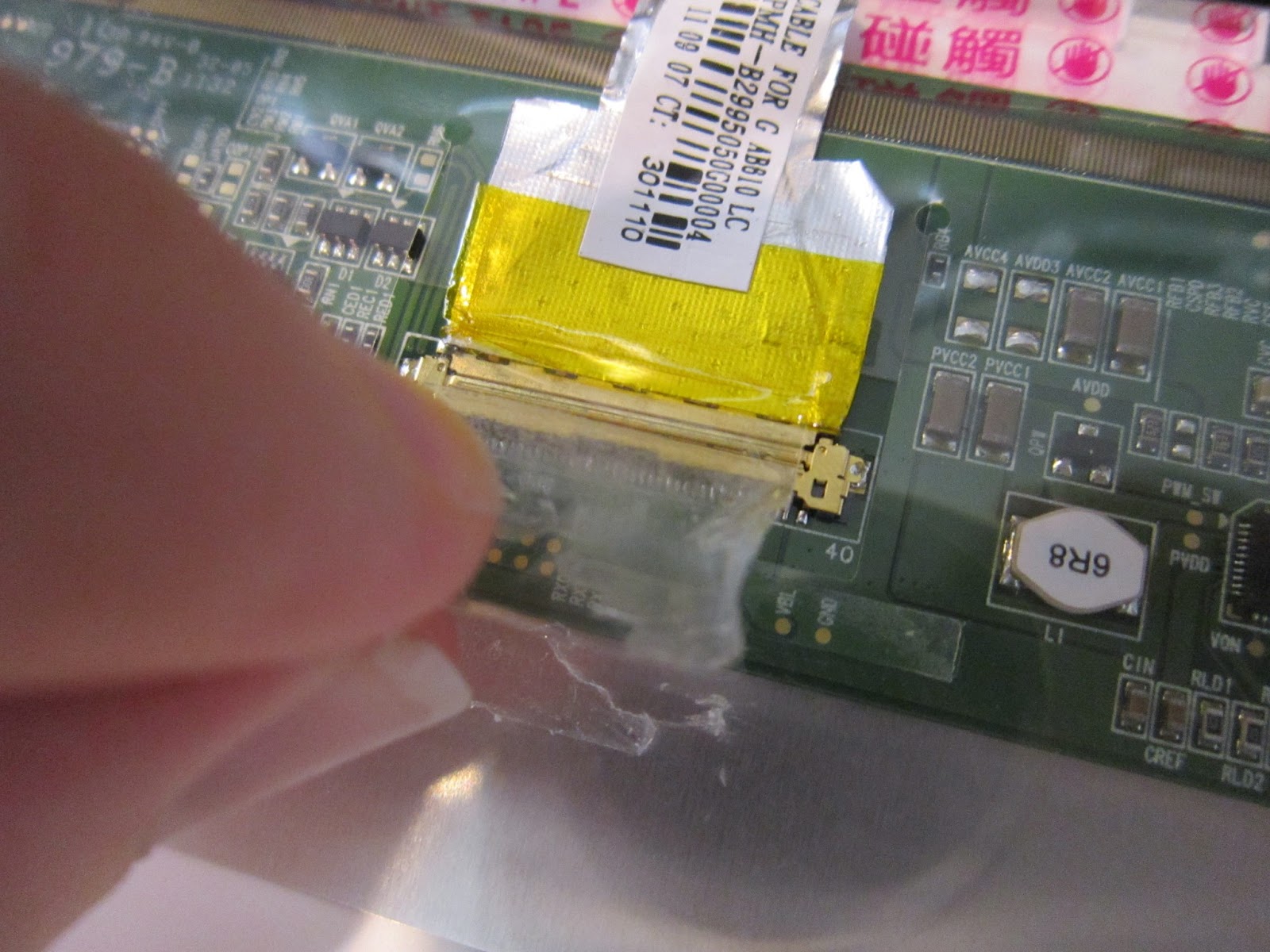
Carefully lift the tape and remove the cable


 There are lots of numbers and labels on the back of the screen. In this case, HP has a sticker denoting the proper replacement. Type this into a reputable vendor such as eBay or Amazon and find the replacement part. My replacement came from HighTechParts on Amazon for $63 including shipping. This was much better for me than paying $329!


I waited in breathless anticipation for it to arrive, tracking its progress from New Hampshire to Massachusetts to Illinois to ... Why is it not moving? I wanted it by Friday so I could send the wife and kids to the zoo Saturday and repair in peace. No such luck. It finally came Monday afternoon. All things considered, we are well and truly spoiled by our technology, industry, and superb infrastructure.


The packaging showed consideration and forethought. The bubble-wrap went both ways around the inner cardboard sleeve...


Which opened up to a plastic sleeve holding a beautiful new screen!


The replacement screen appears to be the same in everything except the labeling on the back, which includes a warning "Don't touch!" in English and Chinese.


Now to replace the screen.


I made a small mistake in leaving the protective plastic on the screen until after I had screwed it onto the frame. The plastic was held on by tape, now secured between the screen and metal frame. There's no way I'm undoing the work just done to remove a bit of tape, so I just carefully ripped it free, leaving as little tape as possible.


Notice how some holes have a little triangle arrow pointing to them labeled "SNR-R" while the one on the far right has no arrow?

That hole on the right is last one filled - after the bezel is replaced.


'Tis a thing of joy and beauty to behold!


A brand new screen with nary a fingerprint on it.
(That'll change soon.)


But... Does it work?


Hooray!
Final thoughts: Replacing your own screen is not for everyone. Popping that bezel off is a bit nerve-wracking. Additionally, it is imperative that you get an exact replacement. However, if you are dexterous, careful, and have some skill with small tools, doing this can easily save you almost $300.

Friday, October 28, 2011

Graduation!

It's been a busy week, but I wanted to share the news - I are edumacated now! Yes, I've finally accomplished what I once thought was impossible. While working full time to support my family, I also went to school full time and kept up my grades to graduate summa cum laude with a Bachelors of Science in Technical Management from DeVry University. There were many ups and downs, and my friends think I was nuts to work during school, but I now know something about myself I didn't before.

My wife, lovely artist that she is, made a smilebox commemorating the event:
Click to play this Smilebox greeting
Create your own greeting - Powered by Smilebox
This digital greeting generated with Smilebox

My youngest had no idea who the strange fellow holding him was! I had to take off my cap so he could recognize me.

“There is no man living who isn't capable of doing more than he thinks he can do.” - Henry Ford

What's next? After a short break to figure my life out, I plan to start my Master's program in May. Wish me luck?

Saturday, October 22, 2011

Shopping for Laptops - Belated conclusion

I finally decided to get the laptop through the HP website, and experienced several benefits by doing so. For about $150 less than the Toshiba, I got the HP Pavilion dv6t, Windows 7 Home Premium 64-bit with everything I wanted: 15" screen, numeric keyboard, 6GB RAM, a full terabyte HDD (the new terabytes have less memory than they used to, sadly. This is because the old memory was measured in powers of 2: 1TB=1024GB. Now they round off to the decimal, so 1TB=1000GB.) over-sized battery, and dual core Intel core i5. With the free XBOX360 it came to less than $800.00. Oh, it also plays Blu-Ray. Or it would if I had any. :-) It is nice to know I have a system that is compatible with all the latest hardware and software and can still communicate with my old laptop.
Speaking of, I have a largish collection of books, movies, and music on my old system. To transfer, I decided to create an ad hoc network. It turned out to be rather simple to do, once I figured it out. First, set up the network on one computer, then connect to that network with the other computer. Voila! Now share the documents folder and start copying. It's rather slow, since the 802.11g and 11.n do not have ad hoc standards required, so manufacturers didn't go the extra mile and put them in. 802.11b is how they talk at a whopping 500 - 600kB/s. 8 hours for my music to copy... and so on. Slow, but it does the job.
I've had some time to get used to it and do some minor customization. For example, the scrolling was very choppy. I hated it. Then I realized that there's a setting for that. Set the scroll from 3 lines to 1 line, and it scrolls much better now. I'm still getting used to the two finger scroll technique. Sometimes it works, and sometimes it doesn't. I've loaded MS Project 2010, and Office 2010 so I can do my schoolwork on it. The 2010 version seems to be easier to use than the ribbon used by the 2007 version. I've installed the PDF reader and upgraded the flash, and that's really it, so far.
The best thing about this laptop, in my opinion, is the boot up time. Minimal. I usually just close the lid to put it to sleep, and when I open it up it's ready to go almost immediately. The integrated fingerprint reader makes logging in to the computer much faster as well. It also saves time when going to my favourite websites. My last laptop lasted through the last few years of my AAS and my BS (about 4 years.) If this one lasts that long I shall be very happy.

Thursday, September 22, 2011

Shopping for Laptops

I'm in the market for a new laptop, considering my current one has a broken hinge and turns itself on at random. My HP Pavilion dv9000 I bought for school has served me well, but it's finally time to retire it. ::sigh:: It lasted me for my AAS in EET and my BSTM. I need something durable, about 15", with 10keypad, a largish HDD and enough RAM to last through my masters program.
I went to the Microsoft Store in Scottsdale. Wow. They sure know how to supply the eye candy! There were two laptops that caught my eye and had the features I need. The white one was $699 and you get a free XBOX360 with it! Woot! Sadly, it is made by Sony. Due to their questionable ethics and propensity to sue their customers, I will not give any money to them.
That leaves the $949 Toshiba Satellite with more RAM (6GB) and larger HDD (750GB) (it has other features as well, but I'm not interested in Blu-ray and WiDi ATM.) It also includes the XBOX360. The laptop itself stretches my budget, and I'd be getting the Kinect with it so the kids can get exercise playing games so there's another $150 to add on. I'm not sure I want to spend the money, but I need a new portable computer.
Hmm. Decisions, decisions. The free XBOX offer ends Saturday, so I have some time to decide.

Saturday, July 2, 2011

The Triops are dead: Long live the Triops

So the last Triops died the other day. It was a good run for them and fun for the kids to watch something grow. No eggs were laid this time, perhaps because there was no sand to lay them in? I still have more sand from the batch last year. Maybe I'll grow them again next year. It was a fun experiment for summer vacation. They may not live very long, and they are very sensitive to environmental changes and pollution, but as a species they are quite successful. Long live the Triops!

Saturday, June 11, 2011

Triops continued

Today is one week since I poured water over sand to see if anything would grow. My Triops have hatched, grown rapidly, and now range in size from 1/4" to 1/2". The largest is one that I transferred into a separate fish tank. I'm guessing it grows faster due to the higher oxygen content since there is a bubbler in the fish tank and none in the makeshift aquarium the others are in. I counted approximately a dozen Triops total. They're hard to count since they move around so quickly. The kids love watching them and I have to remind Martin that he can not touch them because I want them to live a bit longer this time!
MyTriops.com has some lovely pictures and great references on the different species and growing habits.

Wednesday, June 8, 2011

Triops: Living dinosaur, Exciting pet

Triops
Some time ago, about a year past, I bought a Triops kit from Hobby Lobby. To describe them, think of three eyed freshwater shrimp. This is actually where they get their name as "Triops" means "three eyes." Triops are a form of crustacean that have survived virtually unchanged for millions of years, outlasting the dinosaurs. Their habitat is in ephemeral ponds. These are short lived pools of water so the life cycle of the Triops is very short - 20 to 90 days, in fact. They bury their eggs in the mud and when the pools dry up, the adults die, leaving eggs that enter a form of suspended animation known as diapause. In diapause, virtually all cellular activity stops, which allows the eggs to survive until it rains or they are blown by the wind into a pool of water and the cycle starts again. Sales of Triops from Triops.com support the Diapause Foundation, an organization that studies this unique ability. After my own Triops died a year ago from Martin-itis (curious toddler likes to catch them) I saved the sand from the aquarium in a tin, after drying it out. It's been a year, and I wondered if there were any eggs. Yes, I save everything. ::sigh::
Saturday
I poured a portion of sand into a cup and added bottled water. (Tap water doesn't work, even after letting it sit. The reason for this is of a technical nature I found interesting, but then, I am a geek so I'll spare you the details, yes?) Some tiny bits floated. I decanted the floating bits off into an improvised aquarium - any shallow container ought to do.
Sunday
I checked the container in the morning. Much to my surprise, not only were those floating bits viable eggs, but they had hatched already! I added one pellet of Triops food.
Monday
They're bigger. And there are many of them. I would say their parents had lots of fun, but many species of Triops reproduce asexually - no males required. We have a fish tank that has a lone plecostemus in it so I transferred several juvenile Triops into that tank, just to see what would happen. One more food pellet.
Tuesday
Triops can double in size every day after hatching, and these seem to be doing just that. I added more bottled water to give them more room to swim around. They seem to be finishing off their pellets in short order so I gave them another pellet to eat. Triops are omnivorous and cannibalistic when resources are scarce.
Wednesday
At least two Triops in the fish tank have survived and seem to be happy noshing on whatever they find in the water. My main concern is them being sucked up into the filter, but so far they are OK. My originals are also growing nicely and I am considering separating a few to keep at my desk at work. They are fascinating to watch swimming around and eating.
What are they good for?
Someone asked me what they are good for. From what I have researched, Triops: are a good food supply for certain birds (not for humans: lots of chitin 'shell' and not much protein 'meat'), make an excellent lesson source to teach children about life cycles since they complete theirs in less three months, they supposedly eat mosquito larvae, can be used to test water quality, and are under study to see if the Triops' ability of diapause can be used to treat cancer, slow aging, or many other things.
Also, I think they are a cool pet to amaze your friends. "Three eyed shrimp, yeah!"

Monday, April 18, 2011

Rapid Prototypers, 3D Printers: an Exciting Invention

Rapid prototyping technology can best be explained as the latest development in the history of modern manufacturing. “Industrialization marked a shift to powered, special-purpose machinery, factories and mass production. The iron and textile industries, along with the development of the steam engine, played central roles in the Industrial Revolution, which also saw improved systems of transportation, communication and banking.” (History.com, n.d.) Until the industrial revolution in the 1700’s, most goods were hand crafted by artisans who worked on each piece one at a time by hand. This resulted in work that was detailed, but extremely time consuming to create. Eli Whitney is commonly attributed with the invention of interchangeable parts. While this attribution is not entirely accurate, the practice of interchangeable parts introduced the concept of design tolerance. Henry Ford introduced the production line to build his Model T cars at a price that the common person could afford, including his own employees. Production lines efficiencies were improved with the introduction of robotic controls and machinery. CNC machines were created to mill out complex parts out of solid blocks of material such as aluminium. They use a computer to guide the drill, allowing complex shapes to be accurately made repeatedly. Finally, rapid prototypers were invented to be able to create new designs quickly and accurately in house. Instead of emailing a design to a manufacturer and getting the part mailed back a week or a month later, the engineer can literally create a new design and print it out in hours – reducing the innovation cycle time from weeks to hours.
There are a range of Rapid prototypers that utilize a range of printing techniques that depend on the type of material being used and the use of the design. Laser Sintering, annealed powder, photo-resist, and thermoplastic deposition are some main categories, and new types are being developed, such as cell placement for replacement organ printing. Laser sinter machines build by laying down a layer of metal powder and firing a high powered laser at the fine metal grains. This melts and fuses them together layer by layer to create a solid metal object. Annealed powder uses a similar technique only using plastic powder to make each layer and a binder to solidify the powder. The photo-resist method uses a bath of special liquid that hardens when exposed to light to build. Either lasers or a projector can be used to develop the liquid material into solid. The finished project is removed from the bath and allowed to drain, then cured. Thermoplastic deposition is similar to our familiar inkjet printers, except that it melts plastic wire and deposits it on a platter instead of ink on paper. Of recent note there is an experimental design that places living cells in a matrix that may allow us to print out replacement organs in the future. “Researchers can place liver cells on a preformed scaffold, support kidney cells with a co-printed scaffold, or form adjacent layers of epithelial and stromal soft tissue that grow into a mature tooth. Ultimately the idea would be for surgeons to have tissue on demand for various uses, and the best way to do that is get a number of bio-printers into the hands of researchers and give them the ability to make three dimensional tissues on demand,” says Keith Murphy, CEO of Organovo. (Quick, 2009) Currently, only simple veins and arteries have been able to be printed in this manner but the technique shows incredible promise for those needing organ transplants. If ever adult stem cell technology is developed, these technologies together could build replacement organs for patients with no risk of rejection.
Rapid prototypers were originally prohibitively expensive, costing well over $100,000. The high costs limited their use to large corporations and production houses that catered to engineers and architects. “Three-dimensional printing makes it as cheap to create single items as it is to produce thousands and thus undermines economies of scale. It may have as profound an impact on the world as the coming of the factory did....Just as nobody could have predicted the impact of the steam engine in 1750—or the printing press in 1450, or the transistor in 1950—it is impossible to foresee the long-term impact of 3D printing. But the technology is coming, and it is likely to disrupt every field it touches. ... A basic 3D printer, also known as a fabricator or “fabber”, now costs less than a laser printer did in 1985.” (The Economist, 2011) This technology has improved in several ways. Price drops have allowed it to be bought and used by more companies, small businesses, and even avid hobbyists. Currently, the base model price for a professional 3D printer is less than $15,000 from one major manufacturer. For do-it-yourselfers, the RepRap and MakerBot community provide plans and kits to make your own for around $500. “RepRap is a free desktop 3D printer capable of printing plastic objects. Since many parts of RepRap are made from plastic and RepRap can print those parts, RepRap is a self-replicating machine - one that anyone can build given time and materials. It also means that - if you've got a RepRap - you can print lots of useful stuff, and you can print another RepRap for a friend...” (RepRap, 2011) One exciting facet about the DIY approach is that as innovators develop upgrades, the printer can print out many of its own upgrades and replacement parts. Innovations in print heads and stepper controls have resulted in printers with increased resolution. These new printers can make parts with finer detail. Also, engineers and innovators are experimenting to develop printers that can use more materials, from aluminium, steel, plastic, rubber, photo-resist, and even living cells. Newer models even have multiple heads, to print in multiple colours and different materials in the same object. These improvements and cost reductions have allowed 3D printers to expand into new markets and create new businesses. One such business is making custom prosthetics for amputees. Scott Summitt, founder and CTO of Bespoke Innovations writes in one article, “Since this process has gone live, amputees have returned with requests for more parts. More chrome parts, more tattoos, wood accents, debossed text-all is fair game when the process is entirely digital. But like the person who wears it, each fairing is unique in every way. In fact, like nature, the process is fundamentally unable to create anything but unique parts. To us, this thinking treats people who come to us with respect, allowing them to showcase their unique form and treat it as the dynamic sculpture that is the human body. We hope to change their interactions with strangers, replacing the awkward stares with inspired grins, removing some of the discomfort and alienation that many face each day.” (Summitt, 2011) Projects like Summitt’s show the potential to do more than introduce a new gadget into our lives. This application can do much to improve the quality of life for amputees, helping them regain confidence and self esteem.
The future of these prototypers is exciting even when excluding the prospect of further development. “What determines a civilization’s ability to move forward? In large measure, it is mastery over materials. The key indicators of progress— military prowess; the ability to produce goods; advances in transportation, agriculture, and the arts—all reflect the degree to which humans have been able to work with materials and put them to productive use.” (National Science Foundation, n.d.) However, there is a dark side to this, as with any technology. The unscrupulous and unethical may, and indeed probably will, use this technology for evil. While art enthusiasts may look forward to replica paintings – authentic down to the brushstroke! – art dealers will have to prepare for clever frauds. I can easily imagine shops that don’t need to keep inventories. An auto repair shop can easily print out many types of replacement parts from an online catalog so they don’t have to wait for a distributer cap, for one example. However, projectile weapons may someday be able to be printed on demand as well. Manufacturers use mostly man made materials to make shoes, so it is no stretch of the imagination to see boutique shops printing customized footwear for their customers. Mass production is not a prototyper’s forte. Mass customization is the strength and the weakness of prototypers: while they allow for rapid adjustments to structure, form and function of the finished part, there can be no replacement for quality design. When a single manufacturer produces a million pairs of shoes, they can control the quality in house. When a thousand boutique manufacturers can make custom shoes (or any other parts) on the fly, quality of design will vary greatly from one company to the next. If the customer’s shoes fall apart the second day of wearing, they will be understandably upset. If the customer’s car falls apart on the freeway, they will be understandably dead.
One final concern is of a legal nature. One accessory to rapid prototypers is the 3D scanner. 3D scanners work by taking images of an object placed on a rotating base and stitching those scanned images together into a virtual object. This virtual object can then be printed out using a rapid prototyper. While this can be useful in legal applications, like making a scaled or even a life sized bust of yourself – and who wouldn’t want one of those in their library? – it very easily can copy designs that were invented by another. The media is full of stories about the fight between music labels and file sharers. Think then, if this were extended to everything you own. Is your chair authentic? What about your toaster? We have cheap knockoff handbags and clothes that are copies of luxury brands. Soon, you may be able to get cheaply printed jewelry, furniture, and even car parts. While knockoff consumer electronics may cause the inventor to lose revenue, a poorly printed safety device could result in loss of limb or life if it were to fail. Clearly, a set of guidelines that details the limitations of printed parts would be useful, if only as a guide for the purchaser in regards to caveat emptor.
Innovations are limited by the imagination of the inventor, and the tools and raw materials available. As our understanding of materials sciences improves, so does our ability to manipulate the elements around us. Stores today offer devices that would be worth millions just a few decades ago, and they are sold as cheap disposable toys! (Miniature R/C helicopter, anyone?) The end goal of rapid prototype technology is the holy grail of manufacturing: molecular assembly. One of the few hard science fiction concepts that have yet to be attained is the ability to build atom by atom. With this technology, it may be possible to actually copy a live person, with his memory and personality intact. This presents an even bigger conundrum than cloning. Cloning will result in an individual with identical DNA as the host, but with their own memories and personality. If our memories are molecular in nature an atomic copy will result in two individuals with identical memories as well. If you copy the CEO of a corporation, who does his job? How do you prosecute a murderer if he has a copy and you cannot tell which one did the deed? Finally, if one could copy himself, what are the ethical responsibilities to the copy? If a person copies themselves, then kills the copy, is it murder – or suicide? The positives of this technology will, I am sure, outweigh the risks, however. In the future we will be able to assemble exotic chimeras of materials that can be made no other way. Molecular assemblers could be used to construct a space elevator, or replacement organs and limbs. The standards of quality will have a paradigm shift. No longer will we accept something that is off by millimeters when we can get it accurate to the atom. How this will help us as a society is a question that can only be answered by the people that make up our civilization. Our humanity will be the defining author when whatever we imagine can be realized in fact. Let us hope that kindness, charity, and compassion define our humanity.

Works Cited
History.com. (n.d.). Industrial Revolution. Retrieved April 11, 2011, from History: http://www.history.com/topics/industrial-revolution
National Science Foundation. (n.d.). Advanced Materials. Retrieved April 12, 2011, from nsf.gov: http://www.nsf.gov/about/history/nsf0050/pdf/materials.pdf
Quick, D. (2009, December 15). 3D Bio-printer to create arteries and organs. Retrieved April 11, 2011, from gizmag.com: http://www.gizmag.com/3d-bio-printer/13609/
RepRap. (2011, February 19). Main Page. Retrieved April 13, 2011, from RepRap Wiki: http://reprap.org/wiki/Main_Page
Summitt, S. (2011, January 5). Because One Size Doesn't Fit All: Using RTAM to Profoundly Enhance Prosthetics. Retrieved April 14, 2011, from Time Compression: http://www.timecompression.com/articles/because-one-size-doesnt-fit-all-using-rtam-to-profoundly-enhance-prosthetics
The Economist. (2011, February 10). Print me a Stradivarius. Retrieved April 13, 2011, from The Economist: http://www.economist.com/node/18114327?story_id=18114327

Saturday, April 16, 2011

Phone virus scam alert!

So this morning I get a call just as I am waking up. A polite gentleman with a heavy Indian accent (dot, not feather) informs me that he is from Microsoft and my computer has a virus. Groggy, I'm not sure what to do but stall for time. I tell him I'm not near my computer, please call later. So I start some digging. Google is a wonderful search tool! First, I do not allow remote access to incoming calls nor do I give out information to unsolicited callers. I'm pretty sure this is a scam.
Sure enough, the second call gave me enough information to dig up some dirt. 360 PC Support (the company that called) is not Microsoft, and is not a MS partner like they said they were. They are a call centre in Mumbai with a 404 area code call back number (Atlanta, Georgia.) They originally said they were Microsoft. I called them on it and they said they were actually representatives (partners) of MS and that I have a virus on my computer. They have called me three times this morning. The second time I told them to not call me again. They are insisting that I allow them to remote access my computer or my computer will crash. Obviously, I do not allow this.
This type of scam is hard to control, according to several websites I used to research. The Guardian   wrote a good article describing the scam. They are also calling in Australia, and America as well now. http://answers.microsoft.com Apparently, they are using phone lists to call, since I do not share my phone number with MS. Interestingly, he never called me by name that I recall, which is another telltale, since a legitimate organization will call you by name. However, some scammers will have your name, so just because they know who you are does not mean they are legit! Be careful and happy computing!

Monday, March 21, 2011

A Cautionary on Cloud Computing

I'm concerned about cloud computing. It is shaping our future in powerful ways, yet ways that are transparent to the average user. The basis of cloud computing is that bandwidth has increased to the point that consumers don't need to store anything on their computer. The computer will just be a gateway to the internet where all your files are stored.
The advantage to this is that anywhere you go with a mobile device, your files will be readily accessible. You will never have to worry about your hard drive crashing either!
The disadvantages are varied and some are insidious. First, intellectual property (IP) rights will be harder to enforce as the company holding your files may be subcontracting the server space in foreign countries with lax rules regarding IP ownership. Second, search and seizure protections guaranteed by the Constitution will easily be worked around because law enforcement will be searching a database far from your house, not to mention your control. Third, in the case of communication failures, your computer will be useless as it can bring you no data. On a related note, those communication failures may be due to bandwidth controls set up by your service provider. Can you imagine? "I'm sorry, you can't have access to your class paper because you used up your bandwidth allotment watching those movies. Please upgrade your account to continue using the internet." Even worse would be the bill if they allow overages but charge dearly for them, as in cell phone contracts. Finally, control of data will be removed from the user. If it was determined that a song wasn't paid for, or payment was made to the wrong entity, the service provider may just delete it off the server. You will no longer have access to it and you will have little recourse in the case of a mistake.
The removal of control from the consumer results in reduced agency, a failure of one test of ethics. We need to take care shaping our future with technology or it may turn into one we do not wish for.